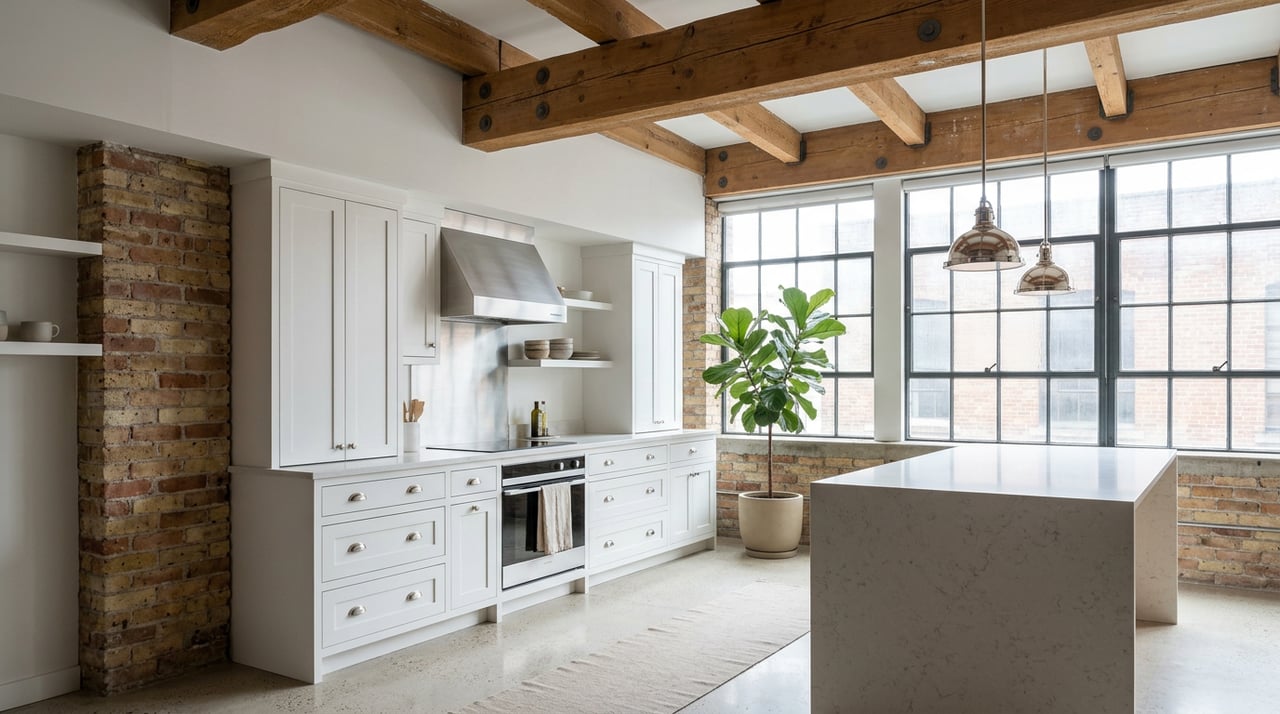
Pull up two one-bedroom lofts in the Mill District right now, both listed within a few thousand dollars of each other, both around 900 square feet, both with the exposed brick and timber beams that make this stretch of Minneapolis look the way it does. On paper they're twins. Walk the buildings and you'll find the real difference isn't square footage or finish level. It's whether a parking stall comes with the deed or whether you're on your own to find one.
That gap doesn't show up in the price-per-square-foot math buyers use to compare listings, and it's rarely the first thing an agent points out on a tour. It should be, because in a neighborhood built almost entirely out of converted flour mills and newer riverside towers, parking is one of the few variables that consistently separates a fair price from an expensive surprise.
Why the Mill District Splits Into Two Parking Eras
The Mill District's housing stock falls into two rough categories, and they were built with very different assumptions about cars.
The historic conversions, buildings like Whitney Lofts on the riverfront (originally an 1879 flour mill), North Star Lofts (a former wool textile mill), and Washburn Lofts (built in 1914 and converted into residences in the 2000s), went up in an era when nobody was pouring an underground garage beneath a grain elevator. Parking in these buildings was frequently added after the fact, as surface lots or leased arrangements rather than something baked into the structure from day one.
Newer construction tells a different story. Buildings like Bridgewater Lofts, sitting across the street from Gold Medal Park, were designed with garage parking as part of the original blueprint, and stalls are more often bundled directly into the sale or rental rather than treated as a separate line item. The 42-story Eleven tower, the tallest residential building in the Mill District, follows the same newer-construction pattern.
None of this is a hard rule. Some historic buildings have solved parking well, and some newer ones still unbundle it. But the tendency is real enough that local market commentary on the neighborhood specifically flags it: expect to pay more for units with deeded parking, and confirm the exact terms during your tour rather than assuming.
What to Check About Parking
Listings may use terms like "deeded parking." Confirm the parking arrangement before comparing units.
Leased parking arrangements vary from building to building. Review the actual declaration and rules rather than relying on the listing sheet.
Then there's the third category: no dedicated parking at all, deeded or leased. In a neighborhood where cobblestone streets and Washington Avenue frontage limit on-street options, that's not a minor inconvenience. It's a recurring cost you'll absorb somewhere else, every month, for as long as you own the unit.
Putting a Number on the Gap
One current Mill District-area rental listing put a second parking stall at $150 a month on top of a unit that already included one indoor heated stall. That's not a sale price, but it's a useful proxy for what structured parking actually costs in this pocket of downtown when it isn't already yours.
Run that forward. A buyer who has to lease a stall instead of owning one outright is looking at roughly $1,800 a year, every year, indefinitely, with no guarantee the rate holds or the space stays available if the building's parking gets reassigned. Compare that to a buyer whose stall is deeded: the cost was baked into the purchase price once, it appreciates or depreciates with the unit.
Neither buyer is wrong to make either choice. The problem is when two listings look identical on price and square footage and only one of them is quietly asking you to carry that cost for as long as you live there.
The Same Gap Shows Up in HOA Dues, Just Better Hidden
Parking costs don't only show up as a separate lease. Sometimes they're folded into monthly association dues instead, which makes comparison shopping even harder because the number looks like it's measuring the same thing across buildings when it isn't.
A sample of current downtown Minneapolis building listings shows just how wide that range runs:
| Building | Typical monthly HOA dues |
|---|---|
| Sable | $558 |
| Riverwalk Lofts | $641 |
| The Crossings | $693 |
| Riverwest | $786 |
| 5th Avenue Lofts | $795 |
| Bassett Creek Lofts | $998 |
Some of that $440 spread reflects unit size and building age, but garage upkeep, guest parking allocations, and shared structural maintenance are part of what pushes dues toward the higher end. A unit with a lower list price and higher monthly dues can erase its apparent savings within a few years, and a buyer comparing two listings purely on sale price will miss that entirely.
The Question That Belongs Before the Offer
Here's the practical version of all this. Before you write an offer on a Mill District or broader Downtown East condo, ask the listing agent three specific things and get them in writing, not as a verbal assurance:
- Is the parking stall deeded to this unit, or assigned through the declaration as a limited common element?
- If it's leased, what's the current monthly rate, who sets it, and how often can it change?
- If there's no dedicated stall at all, what have recent buyers in this specific building actually paid to solve parking nearby?
Ask this on the tour, not after your offer is accepted. A parking dispute is far easier to negotiate into the purchase price than to untangle once you're already living there and the lease renewal notice shows up in a form you didn't expect.
What This Means for the Median You Already Saw
As of early September 2026, the Mill District's 55415 ZIP code counted 56 active listings, a median 46 days on market, and a median sale price near $497,000, up roughly 5.3 percent over the prior year. One-bedroom units in the neighborhood typically range from $400,000 to $750,000, and a two-bedroom around 2,100 square feet runs closer to $800,000.
That spread gets attributed to condition and layout, and it partly is. But parking, deeded, leased, or absent, is one of the quieter forces stretching that range, and it's the one variable a buyer can actually verify before signing anything. The median tells you what the neighborhood is doing. It doesn't tell you which of these two listings is the better deal, and that's a question only a building-by-building look can answer.
FAQ
Does deeded parking show up in the county property record? Ask your agent or title company to review the recorded documents rather than relying on the listing description alone.
What happens if a building has no dedicated parking at all? You'll need to budget for off-site leased parking or plan around street parking, which is limited in the Mill District's dense, historic blocks. Factor that ongoing cost into your comparison the same way you would a lower list price with higher dues.
Is a monthly parking lease part of my HOA dues, or a separate bill? It depends entirely on the building. Some associations fold leased parking into monthly dues, others bill it separately. Get the exact structure in writing before you close, since it changes what your true monthly housing cost actually is.
Every building in this neighborhood tells a slightly different parking story, and the only way to know which story you're buying into is to ask before you tour, not after you've fallen for the exposed brick. If you're weighing a Mill District or Downtown East condo and want someone who already knows which buildings bundle parking and which ones don't, Massad Real Estate can walk you through it. Request a Free Home Valuation to start the conversation.
This article is general information, not legal, tax or financial advice. Consult a qualified professional about your situation.